Returns a named character vector of hex color codes from an Insper palette. When printed interactively, displays a visual color swatch. The result behaves as a plain character vector and can be used directly anywhere colors are accepted.
Arguments
- palette
Character. Palette name. Use
show_insper_palettesto see all options.- n
Integer or NULL. Number of colors to return. If NULL (default), returns all colors in the palette. If
nexceeds the palette size, colors are interpolated smoothly usingcolorRampPalette.- reverse
Logical. If TRUE, reverses the color order. Default FALSE.
Value
An object of class insper_palette (a named character vector of
hex codes). Printing displays a visual swatch. Use as.character() to
strip the class if needed.
Details
Available palettes by type:
Qualitative: main, muted, colorblind, cidades
Sequential: vermelho, turquesa, verde, amarelo, laranja, rosa, roxo, cinza, azul, cidades_folhagem, cidades_solar, cidades_asfalto, cidades_tijolo
Diverging: vermelho_turquesa (default for diverging data), roxo_verde, laranja_roxo, rosa_verde, cidades_folhagem_asfalto, cidades_folhagem_tijolo
Insper Cidades
Palettes prefixed cidades belong to the Insper Cidades sub-brand
(Centro de Estudos das Cidades / Laboratório Arq.Futuro) and are built from
its own application manual rather than the institutional brand kit. They are
opt-in: nothing in the package defaults to them.
Do not mix them with the institutional palettes in one chart. The two
families sit close together in CIELAB: asfalto is only 6.6 dE from
roxo, and solar 8.8 dE from laranja. A chart drawing
from both reads as a rendering error rather than a design choice, so pick
one family per chart.
The Cidades manual ships no tints or shades, so the four cidades_*
sequential ramps are derived: seven steps each, with the official color pinned
at position 4. For diverging data prefer cidades_folhagem_asfalto,
which has the widest colorblind separation of any diverging palette in the
package; cidades_folhagem_tijolo is more symmetric in lightness (so it
reads better in grayscale) but pairs green against orange-red, which is hard
under red-green color vision deficiency.
All palettes are built from the 2026 Insper brand kit except
"colorblind", which is the Okabe-Ito set
(https://jfly.uni-koeln.de/color/) and contains no Insper tokens. It is
bundled as an accessibility fallback for when colorblind readers cannot tell
the brand hues in "main" apart. "main" mixes red, green,
orange and yellow, a difficult combination under the common forms of color
vision deficiency. Use "main" for on-brand work and reach for
"colorblind" when distinguishability matters more than brand fidelity.
Examples
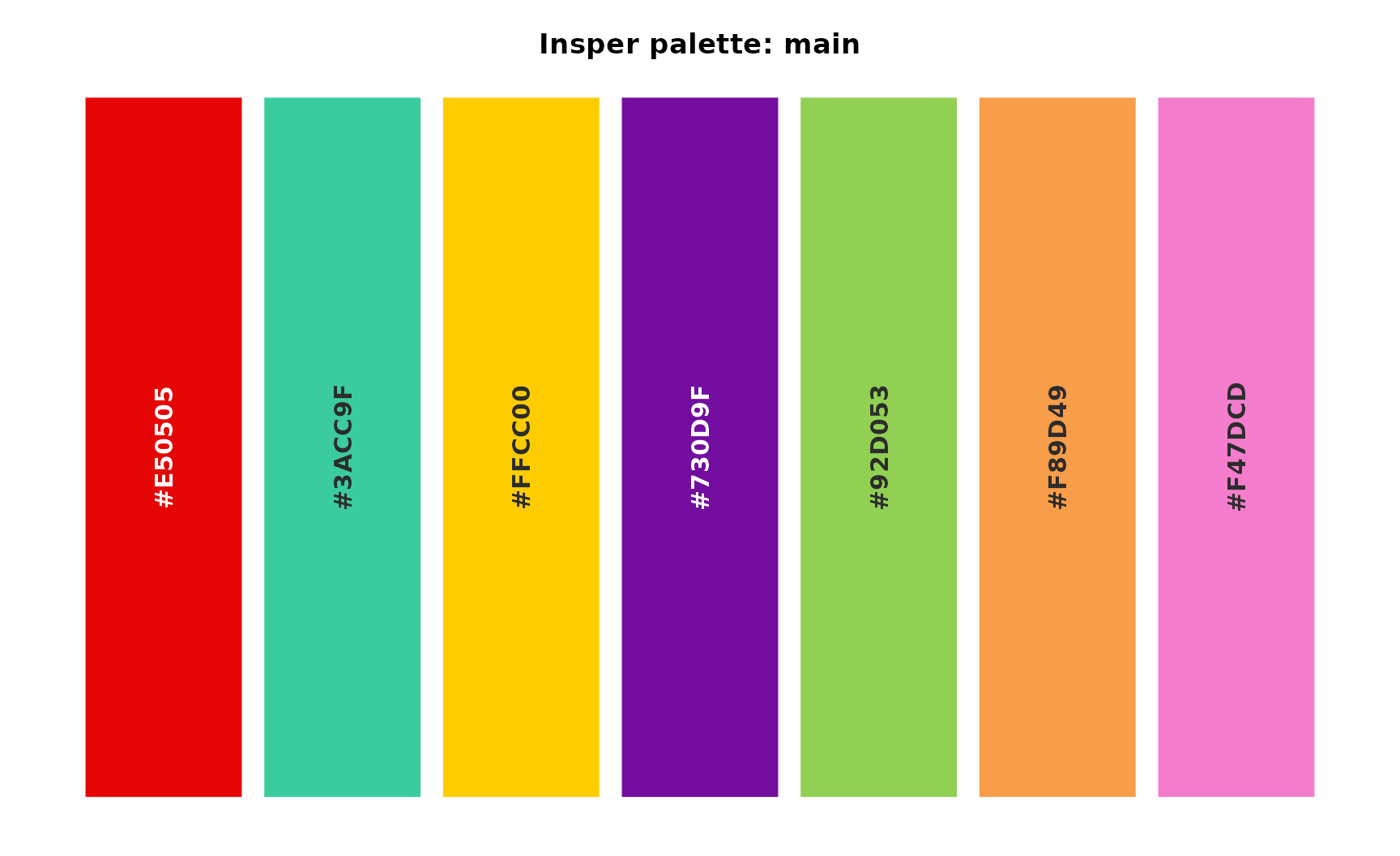
# Get all colors from a palette
insper_palette("main")
 # Subset to n colors
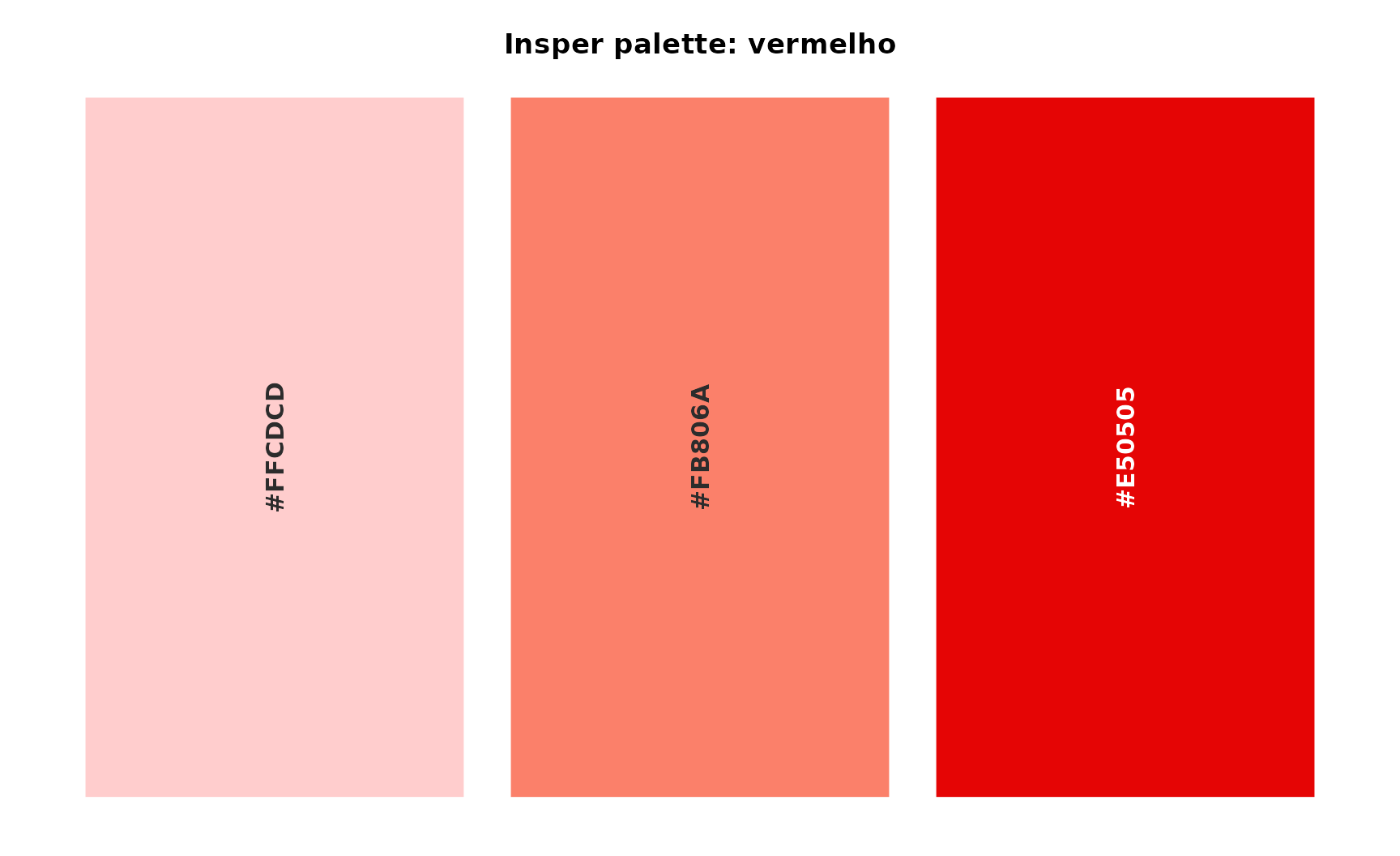
insper_palette("vermelho", n = 3)
# Subset to n colors
insper_palette("vermelho", n = 3)
 # Reverse order
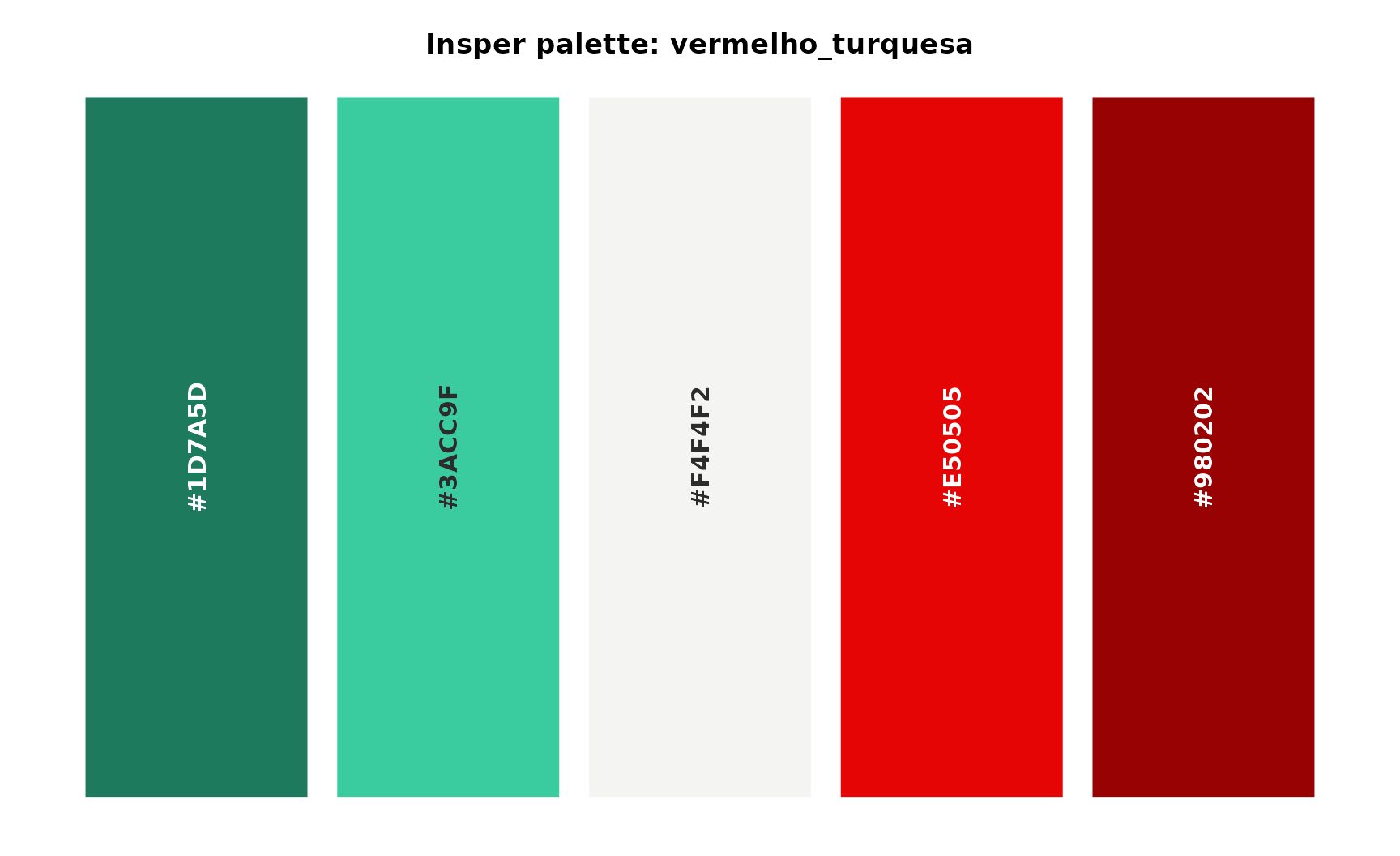
insper_palette("vermelho_turquesa", reverse = TRUE)
# Reverse order
insper_palette("vermelho_turquesa", reverse = TRUE)
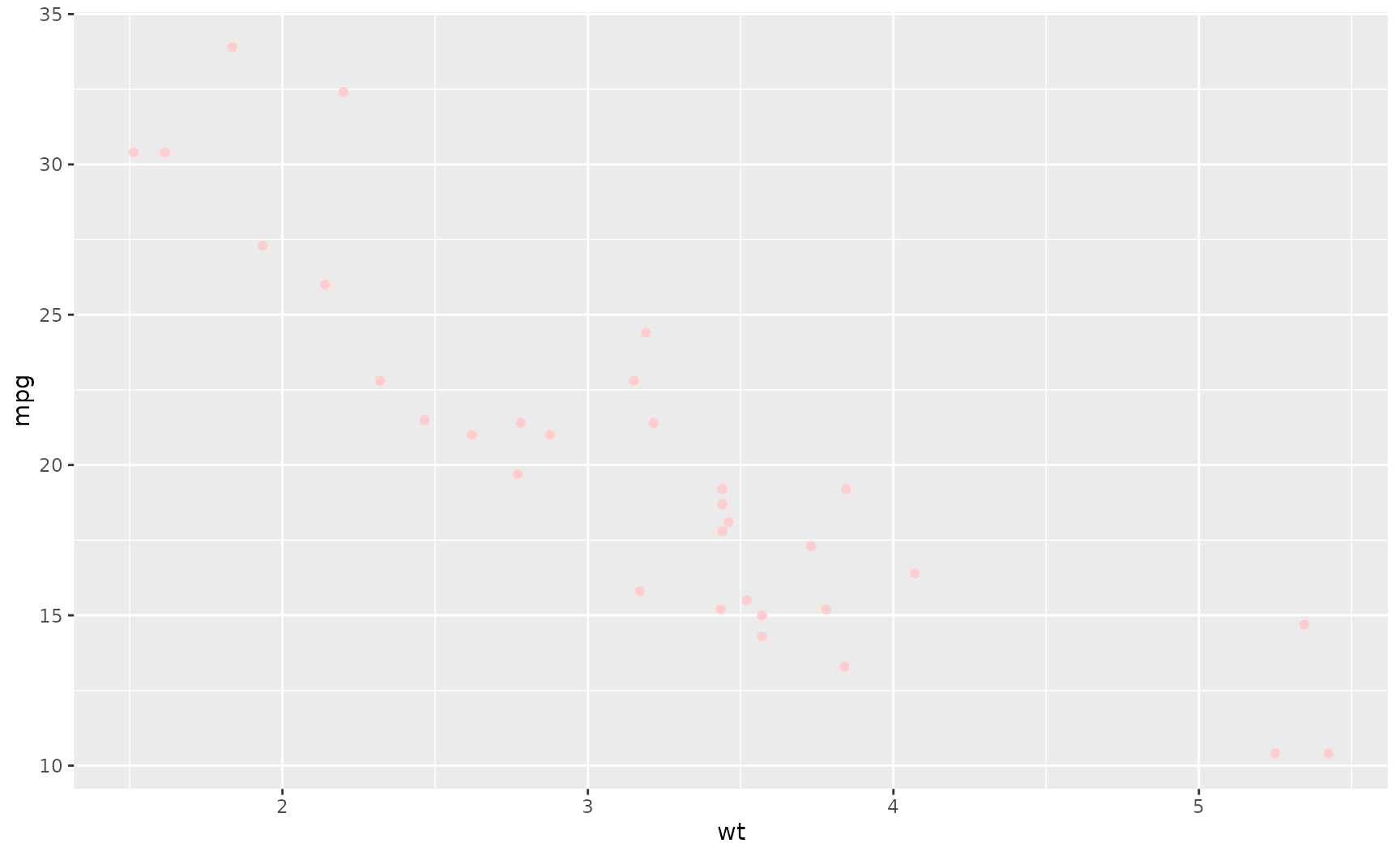
 # Use directly in a plot
library(ggplot2)
ggplot(mtcars, aes(wt, mpg)) +
geom_point(color = insper_palette("vermelho", n = 1))
# Use directly in a plot
library(ggplot2)
ggplot(mtcars, aes(wt, mpg)) +
geom_point(color = insper_palette("vermelho", n = 1))
 # Use in manual scales
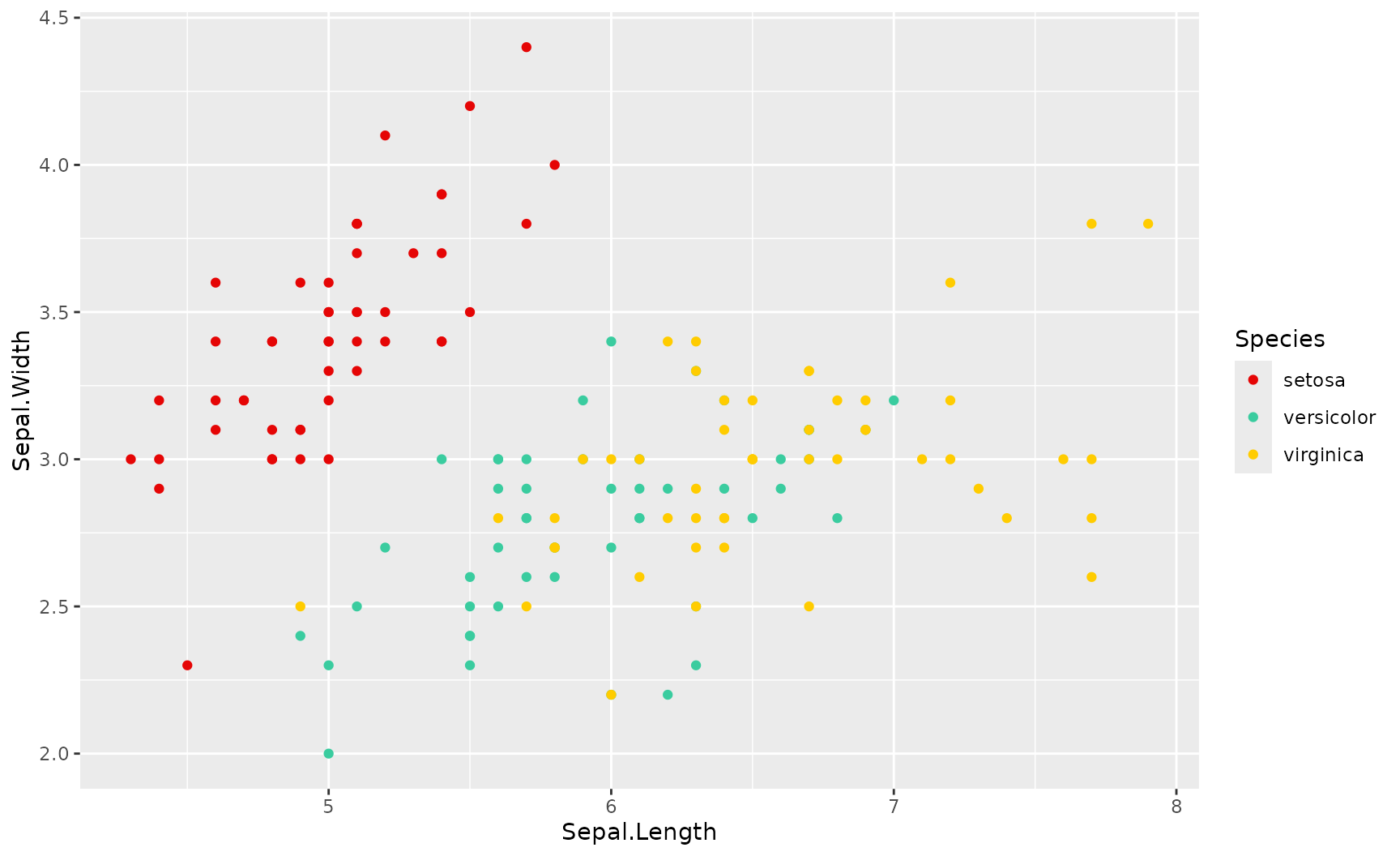
ggplot(iris, aes(Sepal.Length, Sepal.Width, color = Species)) +
geom_point() +
scale_color_manual(values = insper_palette("main", n = 3))
# Use in manual scales
ggplot(iris, aes(Sepal.Length, Sepal.Width, color = Species)) +
geom_point() +
scale_color_manual(values = insper_palette("main", n = 3))